Princeton, TX • Collin County
French Drain Repair in Princeton, TX
Is your French drain backing up, draining slowly, or no longer working at all? Princeton Drainage Co diagnoses and repairs failing systems throughout Collin County, from simple outlet blockages to full clay-migration failures.
Why French Drains Fail in Blackland Clay
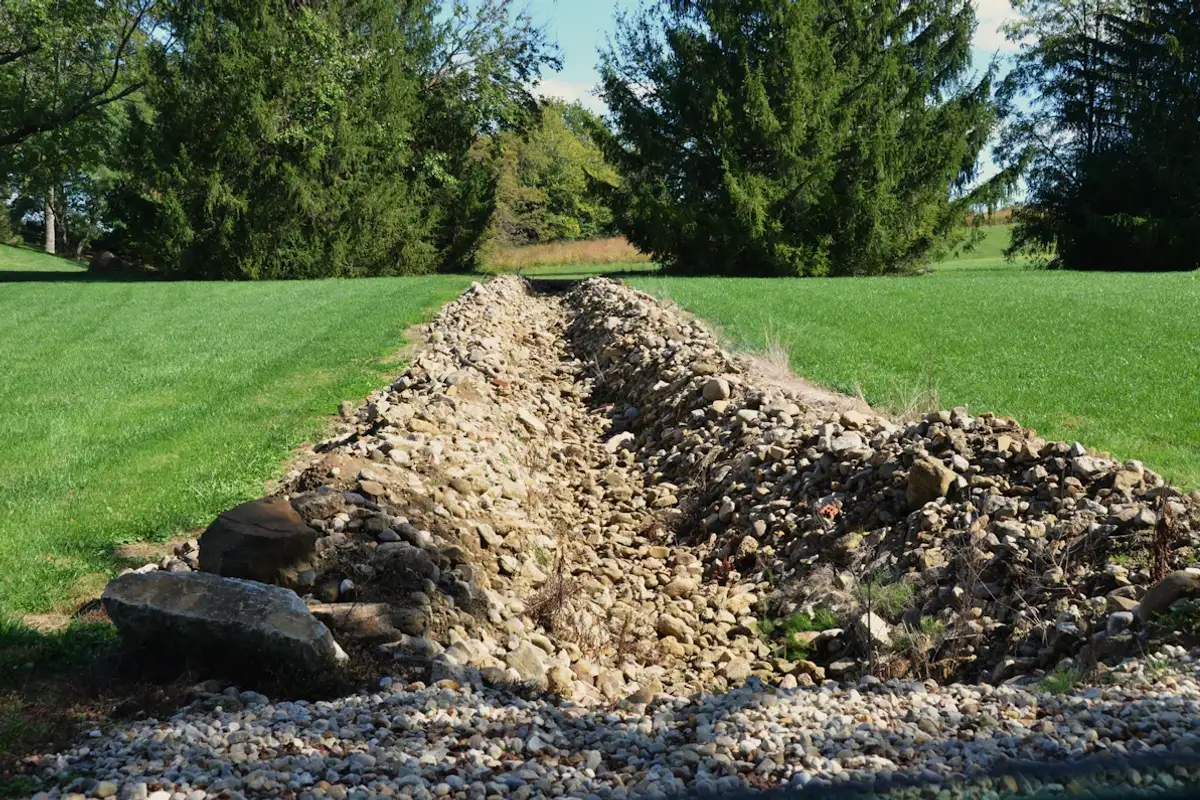
French drains fail for specific, diagnosable reasons. In Princeton and across Collin County, the soil chemistry makes one failure mode far more common than anywhere else: clay migration. Houston Black clay, the dominant soil type throughout the Blackland Prairie, is made up of extremely fine particles that remain suspended in water long after sand and silt settle out. Even with filter fabric around the gravel trench, those clay particles find a way in over time, slowly filling the void space that the drain depends on to collect and hold water before it moves down the pipe.
A French drain doesn't move water like a pipe under pressure. It collects water passively in gravel void space and lets gravity pull it toward the outlet. When that void space fills with clay, the drain becomes a buried clay plug rather than a drainage system. This is why French drains in North Texas clay soils need to be installed with the right gravel depth and filter fabric spec, undersized systems fail in 3 to 5 years instead of 15 to 25.
Repair versus replace deserves an honest diagnosis. Cleaning can restore a partially clogged system and buy more years. But if the gravel pack is clay-saturated throughout, cleaning is a temporary fix and you should hear that upfront.
Signs Your French Drain Needs Repair
Types of French Drain Failures
The most common failure in Collin County. Fine clay particles work through filter fabric over time and fill the gravel void space around the perforated pipe. The drain slows progressively until it no longer moves water. May require partial or full re-excavation and repacking with new gravel and updated filter fabric.
Pop-up emitters at the curb or yard outlet can clog with debris, get buried by settling soil, or fail mechanically. Outlet blockage is the simplest repair, often just cleaning or replacing the emitter and ensuring the pipe end has adequate slope. Check outlets first before any excavation.
Tree roots follow moisture into French drain gravel and can eventually crack or deform the perforated pipe. Affected sections need to be dug up, roots cleared, and the pipe replaced. Root barrier installation near the repaired section can slow re-intrusion. Most common near live oaks, cedars, and older trees within 20 feet of the drain line.
Perforated drainage pipe can crack or flatten from heavy equipment rolling over the yard (HVAC installs, landscaping work) or from soil movement in areas with dramatic seasonal clay expansion. A collapsed pipe section can be spotted by inserting a camera or stiff rod into the inlet. The affected section can usually be replaced without redoing the entire drain.
Surface inlets and catch basins at the collection point can clog with leaves and debris, settle below grade, or lose their grate. When the inlet is blocked, no water enters the system regardless of how clear the pipe and outlet are. Inlet cleaning and catch basin reset are quick repairs.
Over many years, even a well-functioning drain can lose storage capacity as the gravel void fills with fine particles that passed through the fabric. The drain still moves water but much more slowly than when new. This is often the end-of-life condition for older systems, cleaning helps short-term but replacement is the durable fix.
Repair vs. Replace: How to Decide
The repair-versus-replace decision comes down to three things: how much of the system is affected, what the root cause is, and whether the install was done right the first time.
If the failure is localized, one section of pipe crushed, an outlet that needs replacement, an inlet that's settled below grade, repair makes clear sense. Excavate only what's needed and the rest of the system stays undisturbed.
If the gravel void is clay-saturated throughout the trench, cleaning will restore partial function for one or two seasons at best. The clay is still there. The first time it rains hard, it moves again. In this case, full replacement makes sense with updated gravel spec and filter fabric, because a second cleaning 18 months later costs nearly as much and leaves you in the same position.
If the original system was installed with marginal materials, drainage sock instead of proper filter fabric, PVC with large perforations, insufficient gravel depth, repair of the failed section won't prevent the rest from failing on the same schedule. Ask for what was found and the options, honestly laid out.
French drain repair is covered throughout the Princeton service area, not just in Princeton proper.
French Drain Repair: Common Questions
How do I know if my French drain has failed or just needs cleaning?
Can a French drain in Blackland clay really be cleaned, or does it need replacement?
How long should a French drain last in Princeton TX clay soil?
What does French drain repair cost in Princeton TX?
My French drain was working and then stopped after a big storm. What happened?
Can tree roots damage a French drain?
Repair diagnosis and honest repair vs. replace assessment. All of Collin County is covered.
Get a Free QuoteFree diagnosis, and an honest answer on fix or replace.