Princeton, TX • Collin County
French Drain Installation in Princeton, TX
Perforated pipe drainage systems built for Blackland Prairie clay. We solve standing water, yard flooding, and foundation drainage problems for Princeton and Collin County homeowners.
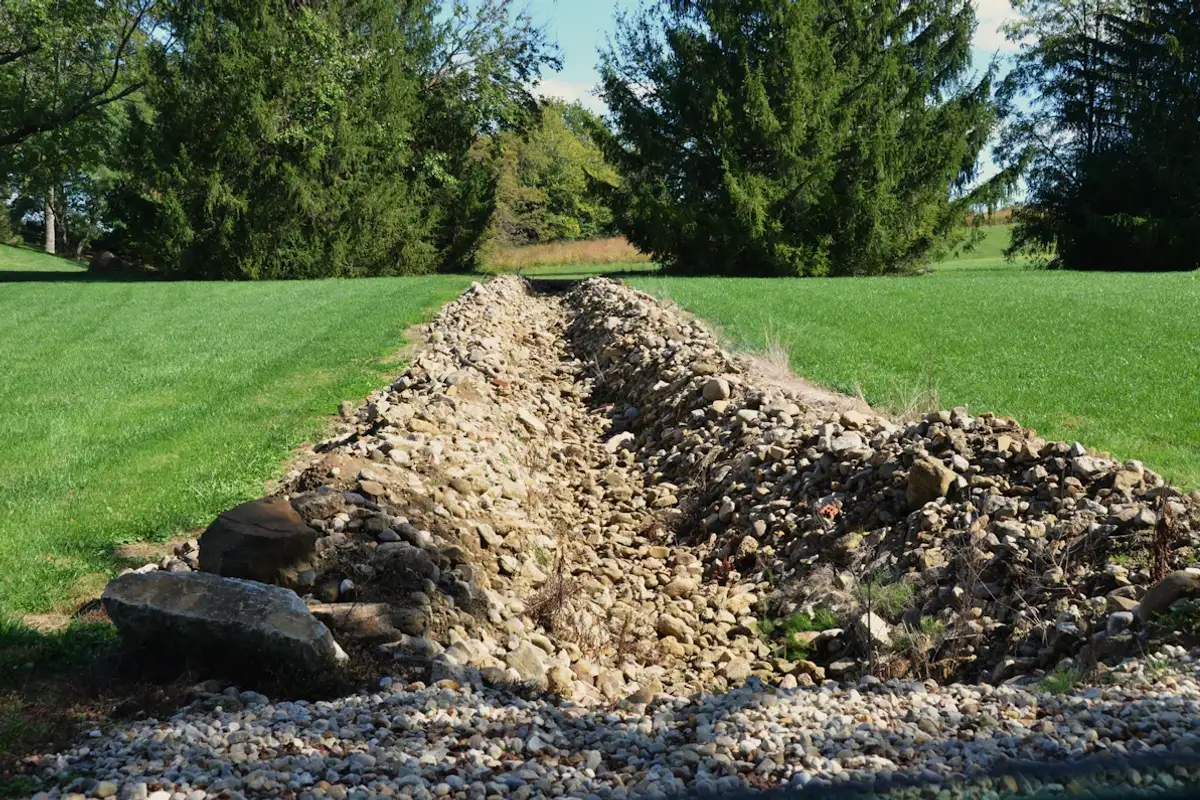
A French drain is a perforated pipe bedded in washed rock, wrapped in geotextile fabric, and trenched at a fall of at least one percent toward a lower outlet. In Princeton the working depth is 18 to 24 inches, because that is where Houston Black clay actually holds its water. Installed correctly, it should run 20 to 30 years without attention. Installed without fabric, it silts shut in five.
Why Princeton Yards Flood
Princeton, TX sits in the heart of the Blackland Prairie, a geological region defined by deep, dark alkaline clay soil. This clay, known as Houston Black, is the official state soil of Texas and the textbook example of a Vertisol. It contains 50% or more clay by volume and has a permeability of around 0.10 inches per hour, roughly 10 times less permeable than typical loam soil. When it rains, the clay swells and becomes nearly impermeable. Water that can't percolate accumulates on the surface or just below it and has nowhere to go.
The soil's other defining property is movement. The plasticity index of Houston Black commonly runs between 40 and 60, with a liquid limit above 70, and the upper ten feet of the profile can change volume by three to six inches between a saturated spring and a cracked August. The series also forms in a repeating pattern of microknolls and microbasins spaced roughly six to twelve feet apart. That is the reason water in a Princeton yard never pools evenly. It gathers in the same specific dips, storm after storm, year after year.
Rainfall makes the difference between an inconvenience and a problem. Princeton averages roughly 40 inches a year, concentrated between April and October, with May the wettest month and a second peak in October. The annual total is unremarkable. The delivery rate is the issue: a single North Texas thunderstorm can drop more in an hour than this clay will absorb in a day. Everything above that rate either stands on the surface or perches in the top foot of soil.
Princeton's population has grown from around 6,800 in 2010 to more than 30,000 today. That growth brought thousands of new homes built on lots that were compacted by heavy construction equipment during the build. Grading, hauling, and concrete traffic close the shrinkage cracks and old root channels that were this soil's only real infiltration path, so a finished builder pad drains more like pavement than like the pasture it replaced. Subdivisions like Bridgewater, Lakeview Estates, and Arcadia Farms see drainage issues that weren't fully addressed in original site development along FM 982 and US-380, and newer communities off US-380 tend to develop the same symptoms once the temporary construction grading settles.
French drains are the most effective solution for this soil type. A properly installed French drain intercepts water before it pools and channels it to a discharge point, keeping your yard and the soil around your foundation far more stable through the year.
What a Princeton French Drain System Includes
Types of French Drain We Install in Princeton
"French drain" covers several different systems. Which one your property needs depends on where the water comes from and where it is allowed to go, and getting that call right matters more than any material choice.
Why French Drains Fail in Blackland Clay
Princeton homeowners who have had a French drain installed before and watched it stop working a few years later almost always ran into one of three problems:
What French Drain Installation Costs in Princeton
French drain work across the Dallas market generally prices between $23 and $36 per linear foot installed, and a complete property drainage system in North Texas commonly totals $3,000 to $8,000. Those are useful anchors, but linear foot pricing hides the variables that actually decide a Princeton quote, so here is how the jobs really break down.
Three factors move a Princeton number more than anything else. The first is distance to a legal outlet: if the nearest lower discharge point is 80 feet from the problem, you are paying for 80 feet of trench that solves nothing on its own. The second is hand digging. Irrigation mains, gas services, and mature root systems rule out a trencher, and hand work in dry Blackland clay is slow. The third is depth near a foundation, where the excavation has to be cut carefully rather than opened up in one pass.
What should make you cautious is a per foot price quoted over the phone. Nobody can price a drainage job without seeing where the water goes, and the bids that come in dramatically under everyone else are usually short on depth, short on washed rock, or missing the geotextile entirely. Those are exactly the three shortcuts that cause the failures described above. We quote flat rate after an on-site visit, and the number does not move once work starts.
Where the Water Goes: Outlets and Princeton Discharge Rules
Every French drain needs somewhere to end. In Princeton the practical options are a pop-up emitter in a lower corner of your own lot, a curb or gutter outlet at the street, an existing drainage easement, or, where no fall exists, a sump and pump. We confirm which of these is available during the site visit, before quoting, because a system without a working outlet is just a gravel trench that fills up.
There is a local dimension to this. Princeton sits in the Tickey Creek sub watershed: the city's storm sewers discharge untreated into Tickey Creek, which flows into Lavon Lake and on to the Trinity River. Lavon Lake is a drinking water reservoir collecting runoff from roughly 768 square miles across Collin, Grayson, Fannin, and Hunt counties through Wilson Creek, Sister Grove, Pilot Grove, Indian Creek, and the East Fork of the Trinity. The city asks residents to keep sediment, clippings, and lawn chemicals out of the inlets for exactly that reason, so a drainage outlet is designed to deliver clean stormwater and nothing else.
The rule that causes the most trouble between neighbors is simpler: you cannot concentrate your runoff onto somebody else's lot. A pipe that ends at the fence line pointed into the yard next door is how a drainage job becomes a legal problem. Most residential French drains in Princeton need no permit at all, but work in a mapped floodplain, work that alters an established drainage pattern, and work involving fill fall under the city's flood prevention ordinance (Chapter 34) and the stormwater provisions of the Princeton Design Standards. FEMA revised the Collin County flood maps in November 2024, so an older survey is not proof of your current zone.
French Drain vs. Surface Regrading in Princeton
Regrading reshapes the surface of your yard to direct water away from problem areas. It's the right fix when water pools because of slope issues. But Blackland clay saturates quickly and stays saturated, so regrading often just relocates the pooling rather than eliminating it.
French drains address subsurface saturation that regrading can't fix. They work by creating a path of least resistance underground, pulling water out of saturated clay before it surfaces. For most Princeton flooding problems you need a French drain. Sometimes you need both: a French drain handles the subsurface water, and regrading directs surface flow toward the inlet. We'll tell you honestly which applies to your yard after we see it.
Service Area Near Princeton
We install French drains throughout Princeton and the surrounding Collin County growth corridor. Lavon and Royse City sit on the same Blackland Prairie clay geology, so the diagnosis and the build are identical there. We also work in Farmersville, Josephine, Caddo Mills, and Copeville. The one local variation worth knowing about is elevation near Lavon Lake: properties on the lower ground closest to the lake hold moisture longer between rain events, which usually means going deeper with the trench and being more careful about where the outlet lands.
French Drain Questions: Princeton TX
How long does French drain installation take in Princeton TX?
What's the best pipe for French drains in Blackland clay?
Where does the water from a French drain go?
How deep should a French drain be in Princeton TX?
Can a French drain fix my Princeton foundation problems?
Do French drains require maintenance in Princeton TX?
What causes French drains to fail in Collin County clay?
Is it better to install a French drain in fall or spring in Princeton TX?
How does Princeton's rapid population growth affect drainage problems?
Can I add catch basins to an existing French drain system?
Will installing a French drain damage my sprinkler system?
Can a French drain work in a yard with no slope at all?
What happens to my lawn during a French drain install?
My neighbor's yard drains into mine. Can a French drain fix that?
Do I need to be home while you install the drain?
French drain installation and yard drainage for Princeton TX and Collin County. Blackland clay specialists.
Get a Free QuoteDo You Need a French Drain?
6 Signs Your Princeton Yard Needs a French Drain
Blackland clay flooding shows up in predictable patterns. Here are the six most common signs Princeton homeowners call us about:
Standing water that lasts 48+ hours after rain
Healthy soil drains surface water within 24 hours. Water still pooling two days later means clay saturation, not a grading issue. A French drain is the fix, not regrading.
Soft or spongy soil patches that never fully dry
Chronically wet spots in Princeton yards indicate a subsurface drainage problem. The clay below has been saturated long enough that it stays soft even between rain events.
Water pooling against the foundation
Foundation-adjacent pooling is the most urgent drainage scenario in Blackland clay. Saturated clay swells against the slab and causes the moisture fluctuation that leads to structural movement.
Grass dying in the same wet patches year after year
Turf that repeatedly fails in the same locations is drowning, not drought-stressed. The wet zones map directly to where subsurface water is accumulating in the clay.
Downspout discharge flooding a neighbor's yard
Discharging runoff onto adjacent properties is a liability in Texas. A French drain connected to your downspouts routes water to a proper outlet rather than across the property line.
Foundation cracks or sticking doors and windows
Houston Black clay shrinks and swells 25 to 40% by volume between dry and wet seasons. That movement is what cracks brick and shifts door frames. A perimeter drain stabilizes the moisture content around the slab.
Free on-site evaluation. Flat-rate quote. No surprises.